
Tummy Tuck FAQ With Dr. Alan Tom at Amelia Aesthetics St. Louis
Plastic surgeon Dr. Alan Tom of Amelia St. Louis answers the most common questions about tummy tucks.
.jpg)
Tummy Tuck in St. Louis: Your Top Questions Answered
Tummy tucks can feel mysterious until you’ve heard someone break them down in plain English: what it really does, who it’s for, what it can’t fix, and what recovery is actually like now (hint: it’s not the horror story your mom’s friend told you 20 years ago).
Below, board-eligible plastic surgeon Dr. Alan Tom of Amelia Aesthetics in St. Louis, Missouri, answers the most common questions about tummy tucks from the Bustmob Community.
What Is a Tummy Tuck?
A tummy tuck (abdominoplasty) is a body contouring surgery designed to:
- Remove excess lower abdominal skin
- Tighten the abdominal wall when needed (diastasis/muscle repair)
- Improve contour, often with strategic liposuction for shaping
It’s not a weight loss procedure. It’s a shape and skin procedure, most commonly for people who are already living a healthy lifestyle but can’t “crunch away” loose skin or stretched muscles.
Who Is a Tummy Tuck Candidate?
A tummy tuck is most commonly for people who have:
- Loose or hanging abdominal skin after pregnancy or weight loss
- A persistent “pouch” or barreled abdomen from muscle separation (diastasis)
- Skin that won’t retract, no matter how fit they get
Dr. Tom emphasizes that extra skin doesn’t disappear with more workouts, and many people blame themselves when the issue is anatomy.
Tummy tucks can be for women and men, including:
- Post-pregnancy patients
- Weight loss patients (including GLP-1 and bariatric patients)
- Younger patients with genetic skin laxity who want contour improvement
Who Is Not a Candidate for a Tummy Tuck?
Dr. Tom frames this as “candidate vs not a candidate,” because it helps people self-screen.
You’re typically not a candidate right now if you are:
- Actively undergoing chemotherapy/radiation
- Fighting an active infection or serious illness
- Not medically optimized for elective surgery
- You plan to lose a significant amount of weight soon
Do I Need to Be at My Goal Weight Before a Tummy Tuck?
Ideally, yes, or at least close. If you plan to lose 30-40+ pounds after surgery, you may end up with loose skin again, and a “redo” tummy tuck is more complex than the first. Waiting until you are closer to your goal weight can save you money and surgery later.
Being closer to your goal weight can also:
- Improve wound healing
- Lower complication risk
- Reduce fluid collections
- Allow for a tighter, more predictable contour
Can I Get a Tummy Tuck If I Want More Kids?
You can, but it’s not always ideal. Pregnancy after a tummy tuck can:
- Stretch the abdominal skin and muscles again
- Change the contour
- Possibly requires revision later
It doesn’t automatically “ruin” the repair, but it adds uncertainty and can make outcomes less predictable. If pregnancy is likely soon, most surgeons will recommend waiting.
What Is Muscle Repair in a Tummy Tuck?
Muscle repair is usually diastasis repair, which involves tightening the separated “six-pack” muscles (rectus abdominis) back toward the midline.
Pregnancy and weight changes can push these muscles outward. When the muscles are separated, patients can look “round” or bloated even when they’re lean.
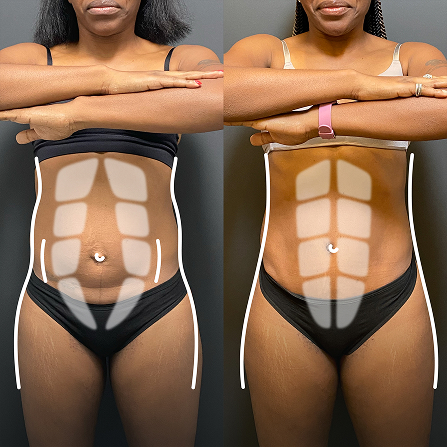
Dr. Tom describes it like restoring the core to a more optimal length so it can function better, often improving:
- Core strength
- Posture
- Comfort with exercise
- In some cases, reducing back pain
Can a Tummy Tuck Help Back Pain or Other “Side Benefits”?
Sometimes, yes. Dr. Tom notes emerging data and patient reports that tummy tuck and muscle repair may help:
- Back pain (for some patients)
- Stress urinary incontinence (for some patients)
- Confidence, comfort in clothing, and activity level
These aren’t guaranteed outcomes, but they’re common “unexpected wins” many patients describe after recovery.
Do I Have to Get Muscle Repair With a Tummy Tuck?
Not always. Some patients mainly need skin removal and contouring, and muscle repair may not be necessary. But for many post-pregnancy patients, the muscle component is a major part of the transformation.
This is one of the most important parts of a consult: what problem are we actually solving—excess skin, muscle separation, fat distribution, or all three?
Why Do Surgeons Have BMI Cutoffs for Tummy Tucks?
It’s not about being “the bad guy.” It’s about complication risk. As BMI increases, studies show higher rates of:
- Wound issues
- Infection
- Fluid collections
- Healing problems
With thicker tissue, the blood supply has farther to travel, and there’s more “dead space” where fluid can accumulate. Some surgeons will still operate at higher BMIs, but the risk conversation becomes more serious.
Should I Work Out Before Surgery?
You don’t need a new intense training plan right before surgery, but being healthy and stable helps. Dr. Tom emphasizes:
- Don’t be aggressively “cutting” weight right before surgery (catabolic state can impair healing)
- Make sure nutrition is solid, especially if you’ve had bariatric surgery or suspect deficiencies
- If you’re at risk, it can be worth checking labs for key nutrients like vitamin A, vitamin C, and zinc
In short, a stable weight and good nutrition beat last-minute gym panic.
Does a Tummy Tuck Include Liposuction?
Often, yes, especially in modern tummy tucks at Amelia. Dr. Tom uses liposuction not only to remove deeper fat but also to assist with safe contouring and improved flap movement (he explains this as “discontinuous undermining,” creating tunnels that help the tissue glide down while preserving vessels and nerves). He also prefers power-assisted liposuction (vibration helps reduce surgeon fatigue, not “energy” delivered into the body).
What About Laser/Ultrasound “Energy” Liposuction?
Dr. Tom is cautious. Energy-based lipo adds heat, which can:
- Can create additional scarring
- Increase contour irregularities
- may cause uneven tightening or dimpling
Some surgeons love it; Dr. Tom prefers avoiding added heat-related risks in many cases.
What’s the Difference Between Visceral Fat and Subcutaneous Fat?
This is the key “why tummy tuck isn’t weight loss” explanation.
- Subcutaneous fat = between skin and muscle (can be addressed with lipo/tummy tuck)
- Visceral fat = around organs inside the abdomen (cannot be removed surgically in a tummy tuck)
Visceral fat is reduced by overall weight loss, not surgery. Even after a tummy tuck, visceral fat can still affect abdominal projection.
Are There Visible Liposuction Scars After a Tummy Tuck?
Usually, no. Dr. Tom places tiny lipo access points within the area that is removed or within the incision zone, so they don’t leave noticeable additional scars, especially in full tummy tucks.
Mini tummy tucks can differ because less skin is removed, so access points may be outside the excision area.
What Happens During a Tummy Tuck Surgery?
A tummy tuck is typically performed in the following steps:
- Tumescent fluid is placed (IV-like fluid + epinephrine/adrenaline to reduce bleeding and protect vessels)
- Liposuction is performed (often first)
- A “football-shaped” section of lower abdominal skin is removed
- Muscle/diastasis repair is performed (stitching the midline tight)
- Skin is pulled down, and the abdomen is closed
- Belly button is brought through and shaped carefully
How Is the Belly Button Created in a Tummy Tuck?
The belly button is often the “dead giveaway” of a tummy tuck, so this matters to a lot of patients. You want the scar to sit inside and the surrounding skin to curve inward so it’s less visible. Dr. Tom says the best way to predict your belly button outcome is:
- Ask your surgeon to show their belly button results
- Discuss any prior belly button scars or hernias
What If I Have an “Outie” Belly Button or Belly Button Hernia?
An outie can signal a hernia. Dr. Tom explains that hernias near the belly button are common, especially after prior laparoscopic surgery or natural abdominal wall weakness. If present, it can often be addressed during surgery, and the belly button can be re-secured to restore a more natural look.
What Can I Do to Improve Scarring After a Tummy Tuck?
Truth is, if there were a miracle scar product, every surgeon would hand it out. Dr. Tom’s simple, evidence-based approach:
- Wait ~6 weeks before starting scar creams/massage (let incisions fully seal)
- Best data supports silicone gel/silicone sheets and massage
- Expect scars to look most red/raised around 2–3 months
- Final scar appearance can take up to 12-18 months
- Avoid sun exposure, use SPF, and prevent early infection/tension issues
What Is a Drainless Tummy Tuck?
A drainless tummy tuck is a combination of advanced techniques that often eliminate the need for post-op drains, support an easier recovery, and result in more natural outcomes. A modern tummy tuck typically uses progressive tension sutures (also called “quilting sutures”) to:
- Reduce the “empty space” where fluid would collect
- Remove tension from the incision (helps scars heal nicer)
- Lower the chance of large seromas and reduce the need for drains
The modern tummy tuck doesn’t make fluid collections impossible, but it can make them smaller and less clinically significant.
Why Doesn’t Every Surgeon Do Drainless Tummy Tucks?
Because surgical technique evolves in waves. Many surgeons:
- Were trained with drains
- Have years of good outcomes with their method
- Prefer gradual change for safety
Dr. Tom’s view: drains aren’t automatically “wrong,” but he’s comfortable with modern methods like drainless closure and liposuction because outcomes support it in his hands.
When Can I Shower After a Tummy Tuck?
At Amelia St. Louis, patients can often shower around 48 hours after surgery (and sometimes sooner if needed), depending on dressings and surgeon instructions.
How Painful Is a Tummy Tuck Compared to a C-Section?
It’s not a perfect comparison, but Dr. Tom’s timeline helps patients set expectations:
- First few days: you’ll want help; you’ll likely be bent over ~30 degrees
- By 5–7 days: standing more upright; moving more easily
- Ideally off narcotics by the 1-week visit
- 2 weeks off work is common (more if your job is physically demanding)
- 6 weeks: back to core workouts and “normal life” progression
Modern recovery is also helped by:
- Long-acting local anesthesia (Exparel)
- Multimodal pain control (Tylenol/NSAIDs, muscle relaxers)
- Encouraged early mobility
How Long Do I Wear a Compression Garment After a Tummy Tuck?
Dr. Tom is “Team Garment.” General guidance when it comes to garments includes:
- Wear it as long as you can tolerate it, up to 6 weeks is ideal
- Garments are helpful, but they are not a “silver bullet”
- If you develop skin irritation, wounds, or you can’t sleep, it can be adjusted or paused
Garments may help:
- Reduce dead space / fluid accumulation after liposuction
- Improve comfort by supporting the core
- Protect clothing and hold the gauze in place
Why Does My Mons Pubis Swell After a Tummy Tuck?
This is incredibly common, and startling if you don’t expect it. If garments compress everywhere except the bathroom opening area, swelling can “collect” there. Dr. Tom also notes liposuction in the mons area is often included when appropriate. Some patients even want the opposite (volume restored), and fat grafting can be discussed in select cases.
What Do I Need to Buy for Tummy Tuck Recovery?
Dr. Tom keeps it practical. You usually don’t need:
- A recliner
- Toilet risers
- A bunch of expensive gadgets
- New fitted clothes
Dr. Tom finds the most helpful items in tummy tuck recovery are the following:
- Hydration drinks
- Stool softeners (especially with opioids)
- Meal prep / easy food plan
- Loose clothing (leggings, baggy sets)
- Pillows/wedge setup to support back and knees
- A helper for the first week
His biggest variable is your home setup:
- stairs vs elevator
- living alone vs. support person
- bed height and bathroom layout
If you have questions about how to plan for your tummy tuck recovery, your surgeon and surgical team are there to help guide you.
Get to Know Dr. Alan Tom
.jpg)
Dr. Alan Tom is a board-elegible plastic surgeon at Amelia Aesthetics St. Louis with a unique surgical foundation. In addition to plastic surgery, he completed training in general surgery and surgical critical care.
That deep understanding of the “inside mechanics,” combined with the aesthetic and sculpting principles of plastic surgery, shapes his approach to tummy tuck surgery: meticulous abdominal wall repair, thoughtful contouring, and modern recovery techniques designed to support both safety and beautiful outcomes.

Ready to start your journey?
.jpg)


