


The Menopause Weight Gain Nobody Warned You About (And What Actually Moves the Needle)
Gaining weight in menopause without changing a thing? Here's how estrogen, insulin, and cortisol shift where your body stores fat, and what actually helps.
You haven't changed your diet. You're still doing the same workouts you've been doing since the elliptical was cool. And yet the scale keeps creeping up, mostly around your midsection, in a way that feels completely unrelated to anything you're actually doing.
If that sounds familiar, you're not imagining it, and you didn't suddenly forget how bodies work. What you're experiencing has a name, a set of causes, and, most importantly, a path forward that doesn't involve maxing out at 1,200 calories a day and crying at spin class.
It's not a discipline problem. It's a hormone problem.
Somewhere along the way, weight loss got treated as a simple math problem: eat less, move more, watch the number go down. That equation was never as simple as it sounds, and during perimenopause and menopause, it breaks down almost entirely.
Research on the menopausal transition shows women gain an average of five to ten pounds during this stage of life, often without any real change in what or how much they're eating. The shift isn't about your willpower packing up and leaving. It's about three hormonal systems – estrogen, insulin, and cortisol – quietly renegotiating where your body stores fat without ever running it by you first.
Estrogen used to be doing you a solid
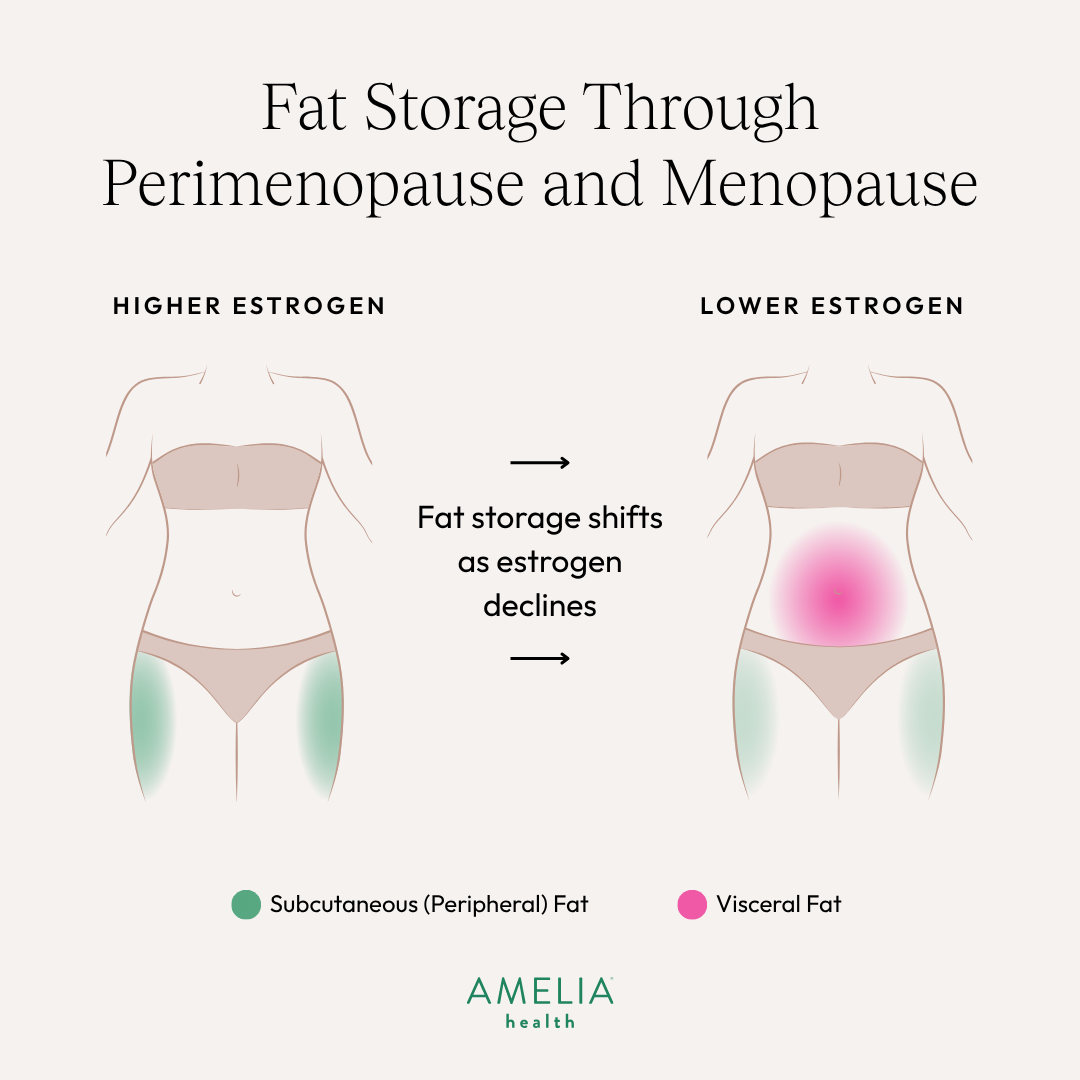
For most of your reproductive years, estrogen played a quiet but important role in fat storage: it directed fat toward your hips and thighs rather than your abdomen. Estrogen helps keep fat tissue metabolically healthy and supports the muscle repair that keeps your metabolism running efficiently.
As estrogen declines through perimenopause and menopause, that role changes. Fat storage shifts from those peripheral areas toward visceral fat, the deeper fat that sits around your abdominal organs. Visceral fat is a different beast than the fat you were carrying in your twenties. It's more metabolically active and can trigger low-grade inflammation that makes losing weight harder. This is why so many women notice their shape changing even when the scale barely moves: the fat is relocating, not just accumulating.
Insulin resistance enters the chat
That shift toward visceral fat doesn't happen in a vacuum. It's closely linked to changes in insulin sensitivity. As central fat increases, many women develop a degree of insulin resistance, meaning cells stop responding to insulin as efficiently as they used to. The body compensates by pumping out more insulin, which itself encourages more fat storage, especially around the midsection.
The result is a loop that feels impossible to break through diet alone: more visceral fat leads to more insulin resistance, which leads to more visceral fat. It's a physiological feedback loop, not proof that you didn't try hard enough.
Cortisol shows up uninvited, per usual
Now add cortisol, your primary stress hormone, and things get extra messy. Midlife tends to arrive with a stress starter pack: caregiving, career pressure, a group chat that never stops, and sleep disrupted by night sweats and hot flashes. Chronic stress keeps cortisol elevated, and elevated cortisol specifically encourages fat storage in the abdomen. It's giving "cortisol face," except it's also giving cortisol everywhere else.
Poor sleep makes it worse. Hot flashes and night sweats fragment sleep for a lot of women during this transition, and sleep deprivation raises cortisol while messing with the hunger hormones ghrelin and leptin, so cravings hit harder and fullness barely registers. None of this is a character flaw. It's your endocrine system reacting to real, measurable stress.
What actually moves the needle
Let's just say it plainly: if the approach that used to work for you has stopped working, that's not a you problem. That's a biology problem, and it needs a biology-informed answer.
As Lea Lott, PA at Amelia Health, puts it: "In midlife, I want women thinking about what they can build, not just what they can restrict. When a patient tells me, 'Something has changed,' I don't want to automatically hand her another restrictive diet. I want to look at the whole picture, her symptoms, sleep, nutrition, activity, medications, medical history, and appropriate metabolic or endocrine evaluation, and figure out what is actually contributing."
Good news: understanding the mechanism changes the strategy, and the right strategy actually works.
Strength training becomes non-negotiable. Not "if you feel like it," but genuinely foundational to your metabolism. Building and preserving muscle mass counteracts menopausal metabolic slowdown and improves insulin sensitivity directly. This matters more now than it did a decade ago.
Protein needs to go up, not down. Supporting muscle and staying full both benefit from prioritizing protein at every meal, rather than defaulting to the low-calorie, low-everything approach a lot of us were raised on by early-2000s diet culture.
Sleep and stress management aren't self-care fluff, they're strategy. Since cortisol and disrupted sleep are directly feeding this cycle, addressing them isn't indulgent. It's foundational for your metabolism, same as the strength training.
The scale isn't the whole story. "I tell patients not to focus exclusively on the number on the scale," says Lott. "During the menopause transition, body composition and fat distribution can change even when total weight hasn't changed dramatically. Preserving muscle and improving metabolic health are often much better goals than simply trying to make the scale go down. At Amelia Health, we use body composition scans along with labs assessing overall metabolic health at each appointment to get an idea of where you actually are and where you actually need to be."
Hormonal and metabolic testing shows you what's actually happening in there. Generic advice can't account for your individual estrogen levels, insulin sensitivity, or thyroid function. A plan built around your own bloodwork hits different than one built around a one-size-fits-all guideline copy-pasted from 2011.
Medical support might be part of the answer, and that's fine. For some women that means hormone balancing therapy. For others it means a medically supervised weight management program, sometimes including medication, alongside nutrition and lifestyle changes. There's no single right path here, and exploring your options isn't giving up. It's just informed care.
You deserve answers, not another diet
If you've spent the last few years feeling like your body stopped listening to you, here's the plot twist: your body isn't broken, and you're not out of options. You just need a plan built around what's actually happening physiologically, not advice written for a body in a completely different hormonal season.
That's the whole idea behind a personalized approach to weight management: real testing, real answers, and a plan built around your biology instead of someone else's blueprint. Or, as Lott sums up the goal of every visit: "My biggest goal is for patients to leave the conversation feeling like they understand their bodies more, feeling validated that they aren't doing anything wrong, and feeling like they have the tools to help move them towards a body they feel comfortable and strong in again."
Don't struggle through this alone. Book a consult at Amelia Health, and let's figure out what's actually going on with your body together.


